
SEO Explained: How to Help Your Website Get Noticed on Google
SEO
Digital Marketing
Website Growth
Introduction
what is seoImagine spending hours creating a website, publishing useful information, and designing attractive pages, only to discover that very few people visit it. This is a common challenge for website owners and beginners in digital marketing. Creating a website is only the first step; helping the right audience discover it is equally important.
Search Engine Optimization (SEO) offers a way to improve a website’s presence in search engines such as Google. It involves making website content more relevant, useful, accessible, and understandable for both visitors and search engines. With a well-planned SEO strategy, businesses and bloggers can reach interested audiences without depending entirely on paid advertising.
In this guide, you’ll learn how SEO works, explore its main types, and discover practical techniques for improving your website’s visibility.
1. Understanding SEO and Its Purpose (What Is SEO )
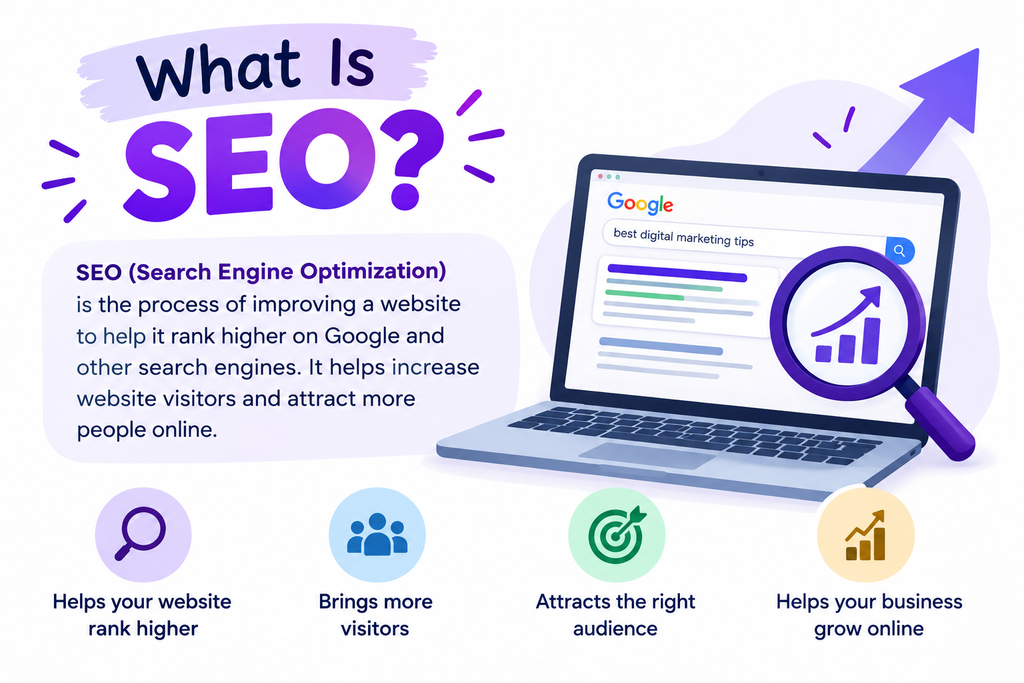
SEO, or Search Engine Optimization, is the process of improving a website so that its pages have a better chance of appearing in relevant, unpaid search results.
Think of Google as a huge digital library containing information from websites around the world. When someone searches for a topic, Google attempts to show pages that best match the person’s needs. SEO helps website owners organize and present their information so that search engines can understand what each page offers.
For example, a digital marketing student who publishes a helpful article about keyword research may attract readers searching for beginner-friendly SEO advice.
The purpose of SEO is to bring relevant visitors to a website through organic search. Rather than paying for every click, website owners work to make their pages useful and discoverable. However, rankings are never guaranteed, and results depend on many factors, including relevance, competition, and website quality.
2. How Does Google Find and Rank Websites? (What Is SEO )
Google uses automated systems to discover webpages, understand their content, and select results for each search. Three important stages help explain this process.
Crawling: Google uses automated crawlers to discover webpages and follow links to find new or updated information.
Indexing: Google analyzes discovered pages and may store them in its search index when they are suitable for inclusion.
Ranking: When a person searches for something, Google’s systems evaluate relevant pages and organize the results according to many signals, including relevance and usefulness.
For instance, if someone searches for “how to improve website speed,” a clear article explaining image compression, caching, and page performance may be relevant to that query.
Website owners can support this process by creating helpful content, maintaining a logical website structure, and fixing technical problems that prevent search engines from accessing important pages.
3. Four Important Types of SEO (What Is SEO )
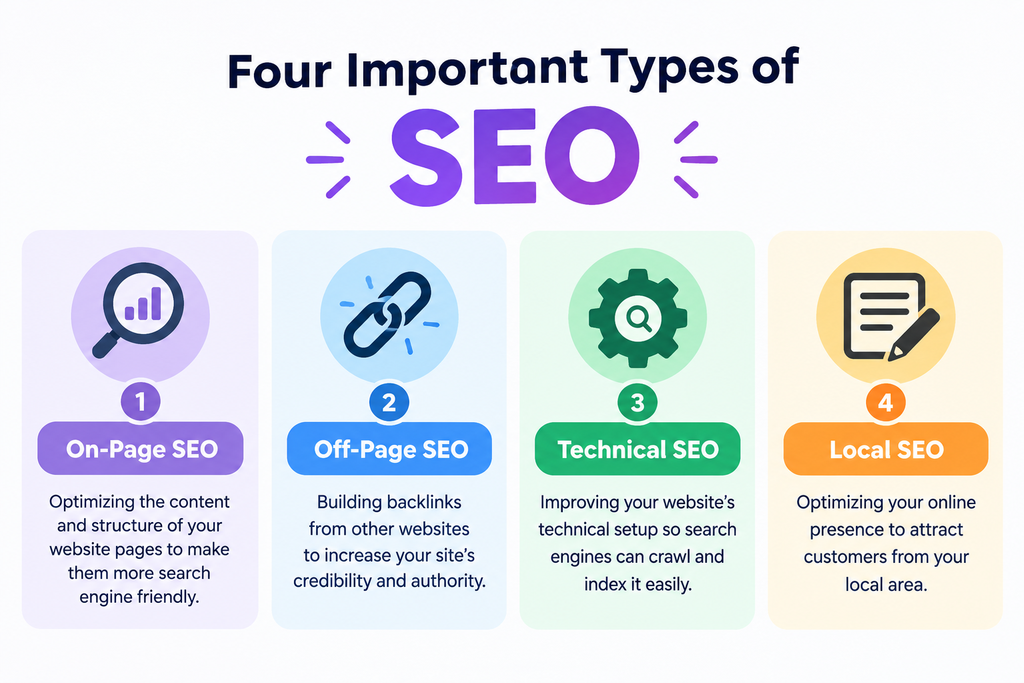
SEO includes several areas that work together to improve a website’s search performance.
On-Page SEO
On-page SEO focuses on improving the content and elements found directly on a webpage. It helps visitors understand the topic and gives search engines useful context.
Common techniques include writing descriptive page titles, organizing information with headings, using relevant keywords naturally, adding meaningful image descriptions, and linking to related pages.
For example, a blog about email marketing could include sections on campaign planning, subject lines, audience segmentation, and performance measurement. This structure makes the article easier to navigate and understand.
Off-Page SEO
Off-page SEO involves activities outside your website that can strengthen its reputation and visibility.
One important example is earning backlinks from relevant websites. A backlink is a link that directs readers from another website to yours. Genuine recommendations from reputable sources can help search engines discover your content and understand its wider relevance.
Creating valuable resources, contributing expert insights, and building professional relationships can support this process. The goal should be to earn meaningful recognition rather than create artificial links.
Technical SEO
Technical SEO improves the underlying structure of a website so search engines can access, crawl, understand, and index its pages effectively.
Important tasks include improving loading performance, ensuring mobile compatibility, using HTTPS, fixing broken links, and checking indexing settings. An XML sitemap can also help search engines discover important URLs.
For someone using WordPress and Elementor, compressing large images and avoiding unnecessary plugins may help improve website performance. A technically sound website provides a stronger foundation for content and other SEO activities.
Local SEO
Local SEO helps businesses reach people searching for products or services in a particular area.
For example, a person searching for “digital marketing services in Malappuram” may be looking for a nearby provider. Businesses can improve their local presence by maintaining accurate business information, managing an eligible Google Business Profile, collecting genuine customer reviews, and publishing relevant location-based content.
This approach is especially useful for local shops, restaurants, service providers, and digital marketing agencies.
4. Why Keywords Matter in SEO (What Is SEO )
Keywords are the words and phrases people use when searching online. Understanding these searches helps website owners create content that matches their audience’s interests and needs.
Consider a beginner who wants to learn SEO. They might search for phrases such as “SEO tips for beginners,” “how Google rankings work,” or “ways to increase organic traffic.”
Keyword research helps identify relevant topics and understand what users expect to find. It is also important to consider search intent: someone looking for a definition needs different information from someone comparing SEO tools or hiring an agency.
Use keywords naturally where they make sense, including page titles, headings, and the body of your content. Avoid repeating the same phrase unnecessarily. Helpful information should always take priority over forcing keywords into every paragraph.
5. Creating Content That Deserves Attention
Useful content gives people a reason to visit your website and spend time exploring it. Rather than publishing articles simply to include keywords, focus on answering genuine questions and solving real problems.
A strong digital marketing blog should use simple explanations, practical examples, clear headings, and accurate information. Where appropriate, include original observations, relevant images, and links to trustworthy sources.
For example, instead of writing only about the definition of SEO, you could demonstrate how improving a page title, organizing headings, or compressing an image can benefit a website.
Updating outdated information and removing confusing explanations can also improve the reader’s experience. Content should be created primarily for people, not just to influence search rankings.
6. Measuring Your SEO Progress (What Is SEO )
SEO requires ongoing attention, and measurement helps you understand which efforts are working.
Google Search Console can show how often your pages appear in Google Search, which queries generate impressions and clicks, and how your pages perform in search results. Google Analytics can help you understand website visits and what users do after arriving.
Useful measurements include organic clicks, impressions, click-through rate, relevant keyword performance, and conversions such as contact form submissions.
For example, if a blog receives many impressions but few clicks, you could review whether its title accurately reflects the information readers are looking for. Changes should be evaluated over time because search performance can fluctuate.
7. Common SEO Mistakes to Avoid (What Is SEO )
Beginners can waste time by focusing on shortcuts instead of building a useful website. Avoid copying articles from other websites, stuffing keywords into paragraphs, buying spammy backlinks, ignoring mobile usability, and publishing content that does not answer the reader’s question.
It is also important to avoid expecting immediate results. SEO often takes time, and even well-optimized pages may not reach the top positions. Consistent improvements, accurate information, and a positive user experience are more valuable than chasing quick ranking promises.
If you Want Learn MoreHOME
Conclusion
SEO helps website owners connect their content with people searching for relevant information. By combining useful writing, thoughtful keyword research, on-page improvements, technical maintenance, and genuine off-page recognition, you can build a stronger foundation for organic website growth.
For digital marketing students, applying these techniques to a personal portfolio is a practical way to develop real skills. Start with one useful article, make sure your website is accessible on mobile devices, and use Google Search Console to monitor performance.
Ultimately, effective SEO is not simply about getting a page to appear on Google. It is about making your website easier to discover and giving visitors information that genuinely helps them.